
A deep breath isn't the same as a big breath

Most people, when asked to take a deep breath, lift their shoulders, expand their chest and take in a large gulp of air.
I know because I've watched rooms full of yoga students do it.
And, for years, I gave exactly the same instruction.
“Take a deep breath.”
But here's what I eventually realized:
A big breath and a deep breath aren't necessarily the same thing.
One describes how much air you're taking in.
The other describes how you're breathing.
That distinction changed the way I understand breath — and eventually, the way I teach it.
Deep doesn't mean big
We've become so used to the instruction “take a deep breath” that most of us don't stop to consider what deep actually means.
We tend to interpret it as more.
A bigger inhale. More air. Chest expanding. Shoulders rising. Sometimes even an audible gasp.
But that's volume, not depth.
For me, a deep breath means something different: the breath moves deeper into the body because the diaphragm is able to do its work and the lower torso can expand three-dimensionally.
The diaphragm is the primary muscle of breathing — a large, dome-shaped muscle sitting beneath the lungs. As you inhale, it contracts and descends, creating space for the lungs to expand. The lower ribs can widen and the abdominal wall can move naturally in response.
And this movement isn't only forward into the belly.
It's three-dimensional.
Front. Sides. Back.
A deep breath doesn't have to look dramatic from the outside. The shoulders may barely move at all.
Upper-chest breathing, on the other hand, often becomes more pronounced when we're stressed or physically activated. The shoulders and accessory breathing muscles begin doing more of the work, and the breath may become faster, larger or more effortful.
There's nothing inherently wrong with that. Your body needs different ways of breathing for different states. If you're running up a hill, your breathing should change.
The problem is when a breathing pattern that supports activation becomes the way we breathe much of the time — sitting at a desk, driving the car, answering emails, lying on the sofa.
So I've stopped thinking about breath in terms of good breathing and bad breathing.
I find these three distinctions much more useful:
Big tells us about volume.
Deep tells us about movement — diaphragmatic and three-dimensional.
Efficient tells us whether the breath matches what the body actually needs in that moment.
And those are not necessarily the same thing.
What Buteyko changed for me
My understanding of this changed significantly when I trained and became certified in the Buteyko Method.
After years of yoga and pranayama, I encountered an idea that initially sounded almost backwards:
Sometimes the answer isn't to breathe more. It's to breathe less.
Or perhaps more accurately: to breathe more efficiently.
The Buteyko Method, developed by Ukrainian physician Konstantin Buteyko, is built partly around the observation that many people habitually overbreathe — breathing more air than the body's metabolic needs require.
And this is where the physiology gets interesting.
We tend to assume that if oxygen is good, taking in more air must mean getting more oxygen.
But respiration doesn't work quite that simply.
When we habitually breathe more than the body requires, we can exhale carbon dioxide faster than the body is producing it, lowering CO₂ levels in the blood.
Carbon dioxide isn't simply a waste gas that needs to be removed. It also plays an important role in how readily haemoglobin releases oxygen to the tissues — a relationship known as the Bohr effect.
So more breathing doesn't automatically mean better oxygen delivery.
That's one of the ideas I find most useful in the Buteyko Method: more air is not necessarily better breathing.
This doesn't mean deliberately starving yourself of air or forcing tiny breaths when your body genuinely needs more. And it certainly doesn't mean large breaths are inherently wrong. During exercise, for example, your metabolic demand changes and your breathing appropriately changes with it.
It's about efficiency.
Using the breath you actually need for the state you're in, rather than habitually breathing more, faster or harder than the moment requires.
Once I understood that, the instruction I'd used for years — take a deep breath — started to mean something very different.
Not:
Take in as much air as you can.
But:
Can this breath become quieter, easier and more three-dimensional?
Why nasal breathing matters
One of the simplest shifts within the Buteyko approach is also one of the least dramatic:
Breathe through your nose whenever you comfortably can.
The nose isn't simply a smaller version of the mouth.
It filters, warms and humidifies incoming air. Nasal breathing also naturally creates more resistance to airflow than breathing through an open mouth, which can help moderate the volume and pace of breathing.
For many people, simply closing the mouth and allowing the breath to move quietly through the nose changes the quality of breathing without needing to do very much at all.
I notice this with students frequently.
Instead of asking someone to take a bigger breath, I can invite them to close their mouth, let the breath move through the nose, soften the shoulders and notice what happens.
Often the breath becomes quieter almost by itself.
And I think that's an important distinction.
We're so accustomed to approaching breathwork as something we need to do that we can miss how much of it is actually about removing unnecessary effort.
Less can genuinely be more
This may be the most counter-intuitive part.
If you feel stressed, the instinct is often:
I need a really deep breath.
And what follows is an enormous inhale.
But if you're already breathing more than your body needs, repeatedly adding large breaths isn't necessarily the signal your system is asking for.
Sometimes what helps is almost the opposite.
A quieter inhale.
Through the nose.
Less movement in the shoulders.
More freedom around the lower ribs.
A relaxed exhale that doesn't need to be pushed.
Smaller than you think. Quieter than you think. Less effort than you think.
This is one of the things I most appreciate about the Buteyko Method.
It doesn't ask me to make the breath impressive.
It asks me to pay attention to whether the breath is appropriate.
Yoga and Buteyko gave me different languages for the same body
What fascinates me is that learning Buteyko didn't replace what I'd learned through yoga.
It gave me another language for looking at breath.
Yoga and pranayama have spent centuries exploring the relationship between breath, attention, energy and state through embodied practice. And pranayama is extraordinarily varied — some practices quiet and subtle, others deliberately strong, energizing or forceful.
Buteyko approaches breathing through a different lens, grounded in respiratory physiology and the consequences of habitual breathing patterns.
I don't need those traditions to be identical for them to illuminate each other.
One gives me the language of prana, awareness and lived experience.
The other gives me another way to understand breathing patterns, respiratory chemistry and efficiency.
My work lives somewhere in the conversation between them.
And perhaps that's why my teaching around breath has changed so much over the years.
I no longer think the goal is to teach everyone one “correct” way to breathe.
I'm much more interested in helping someone become aware enough of their own breath to recognize what it's doing — and whether that pattern is actually useful for the state they're in.
Try this while you're reading
You don't need to wait for a formal breathwork practice to explore this.
Sit however you're sitting now.
If it's comfortable, place your hands around your lower ribs — or place one hand somewhere around your upper chest and the other around your lower ribs or abdomen.
Then don't change anything.
Just breathe.
Don't decide which part of your body should move.
Notice what your breath already does.
Does it feel quiet or effortful?
Do your shoulders move?
Where do you feel expansion?
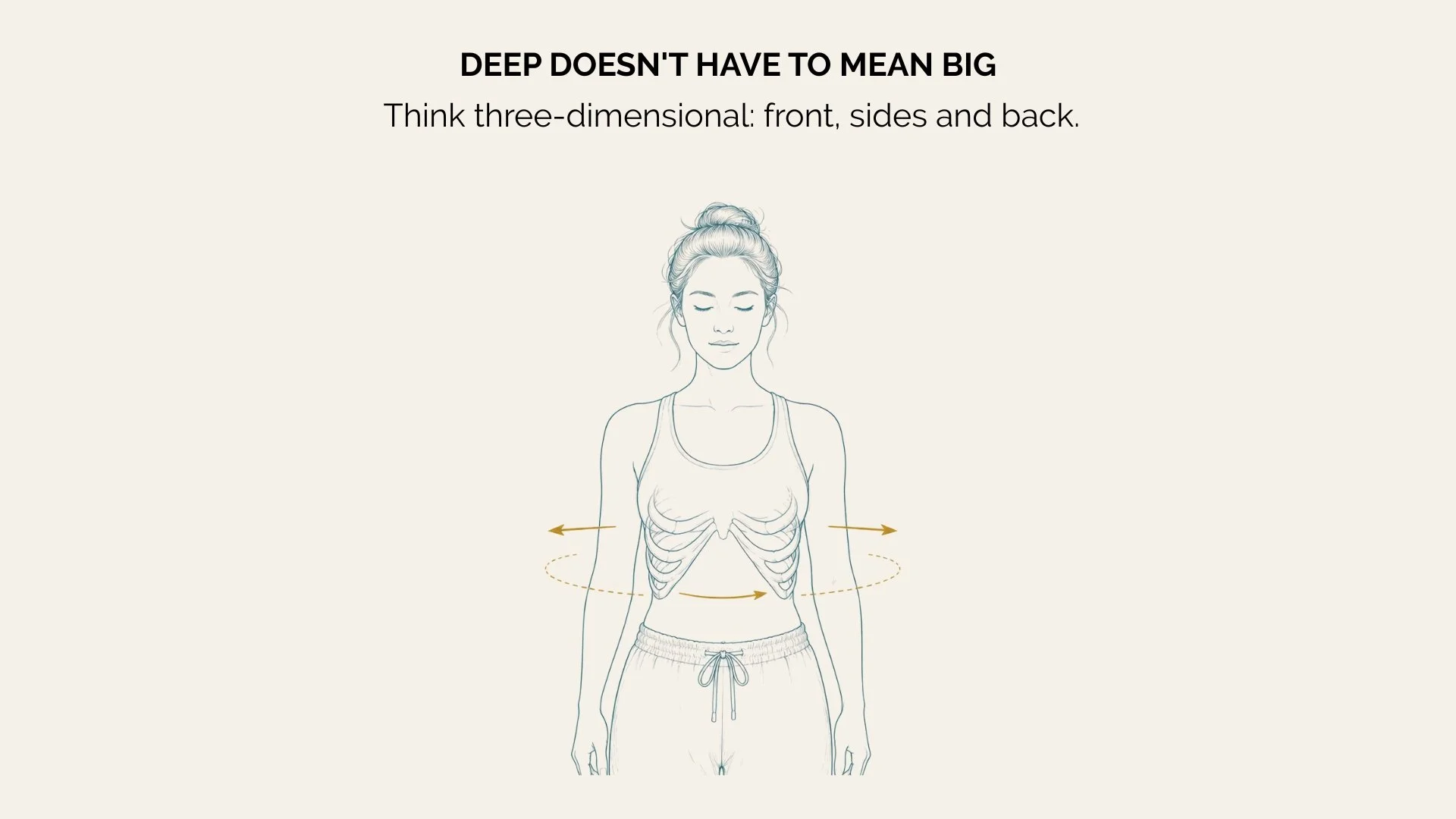
Does your breath seem to move mostly in one direction, or can you sense movement around the sides and back of your lower ribs too?
Now let the next inhale come quietly through your nose.
Instead of deliberately taking more air, see whether you can use less effort.
Let the lower ribs soften outward — front, sides and perhaps even into your back.
Keep your shoulders easy.
Then let the breath leave quietly through your nose, without pushing it out.
Try that again.
No enormous inhale.
No need to fill yourself completely.
Just a few quiet breaths.
See whether the movement can become a little more three-dimensional and the effort a little less.
Quieter rather than bigger.
And notice what happens.
Not what you're supposed to feel.
What actually happens in your body.
Why this can be harder to change than it sounds
Of course, noticing your breathing pattern once doesn't mean you'll breathe this way automatically tomorrow.
Breathing patterns are deeply habitual.
They respond to stress, posture, movement, emotion, illness, environment and years of repetition.
And our bodies adapt to the positions we spend our lives in.
Many of us spend hours sitting slightly forward over laptops and phones. The ribs, chest and upper back may not move as freely as they once did. The diaphragm doesn't exist separately from the rest of the body; breathing is affected by the space available for movement.
That's one reason I don't teach breath as though it's merely a respiratory technique.
Sometimes the body needs movement.
Sometimes the ribs need space.
Sometimes the shoulders need to stop trying to help.
Sometimes you simply need to notice that you've been holding your breath while answering an email.
Breathwork and embodiment belong together.
And like any embodied pattern, breathing changes through repetition rather than through one moment of intellectual understanding.
You can understand everything I've written in this article and still find yourself tomorrow morning with your shoulders somewhere near your ears.
I still do.
The difference is that I notice sooner.
Breath is often the first thing I notice now
Over years of paying attention to this, I've noticed that my breath is often one of the first things to change when my state changes.
Sometimes it happens before I've consciously registered that I'm stressed.
My jaw tightens slightly.
My shoulders shift.
The breath gets shorter or becomes more shallow.
That's not a failure.
It's information.
My body has responded before my thinking mind has caught up.
And this is one of the reasons breath has become such an important part of my work: it gives me a way to notice my state in real time.
The breath is automatic, but it's also something we can influence consciously.
That makes it an unusual bridge.
I can notice:
My breathing has changed.
And instead of immediately telling myself to calm down, I can become curious.
What does my body need right now?
Perhaps I need to settle.
Perhaps I need more energy.
Perhaps nothing needs changing at all.
But I'm no longer disconnected from the signal.
That's what has changed most for me.
Not that I breathe “perfectly.”
I notice.
And I know how to respond.
Where breath fits into the Regulation Ritual
This is one reason breath has a place inside the Regulation Ritual.
Not because I think you need another breathing technique to remember when you're already overwhelmed.
Quite the opposite.
I want you to become familiar enough with your own breath that you begin to notice the shift before overwhelm has fully arrived.
The shoulders lifting.
The jaw tightening.
The breath becoming higher, faster or more effortful.
And then to have something simple enough to return to.
The breath practice inside the Regulation Ritual draws on what I've learned through yoga, embodiment and my Buteyko training — not to teach you one perfect breath, but to help you become more aware of the breath you already have and how to work with it.
Grounding, breath, sound and deep rest aren't emergency measures inside the Regulation Ritual.
They're practices we return to.
Because regulation becomes much more useful when it isn't something we remember only after we've reached our limit.
If you'd like to be the first to know when the Regulation Ritual opens, the waitlist is here:
soulbreathyoga.com/regulation-ritual
Not a dramatic breath.
Not the biggest inhale you can take.
Just the breath the moment actually needs.
Perhaps learning to breathe better isn't really about learning how to take a deeper breath. It's learning when you don't need such a big one.