
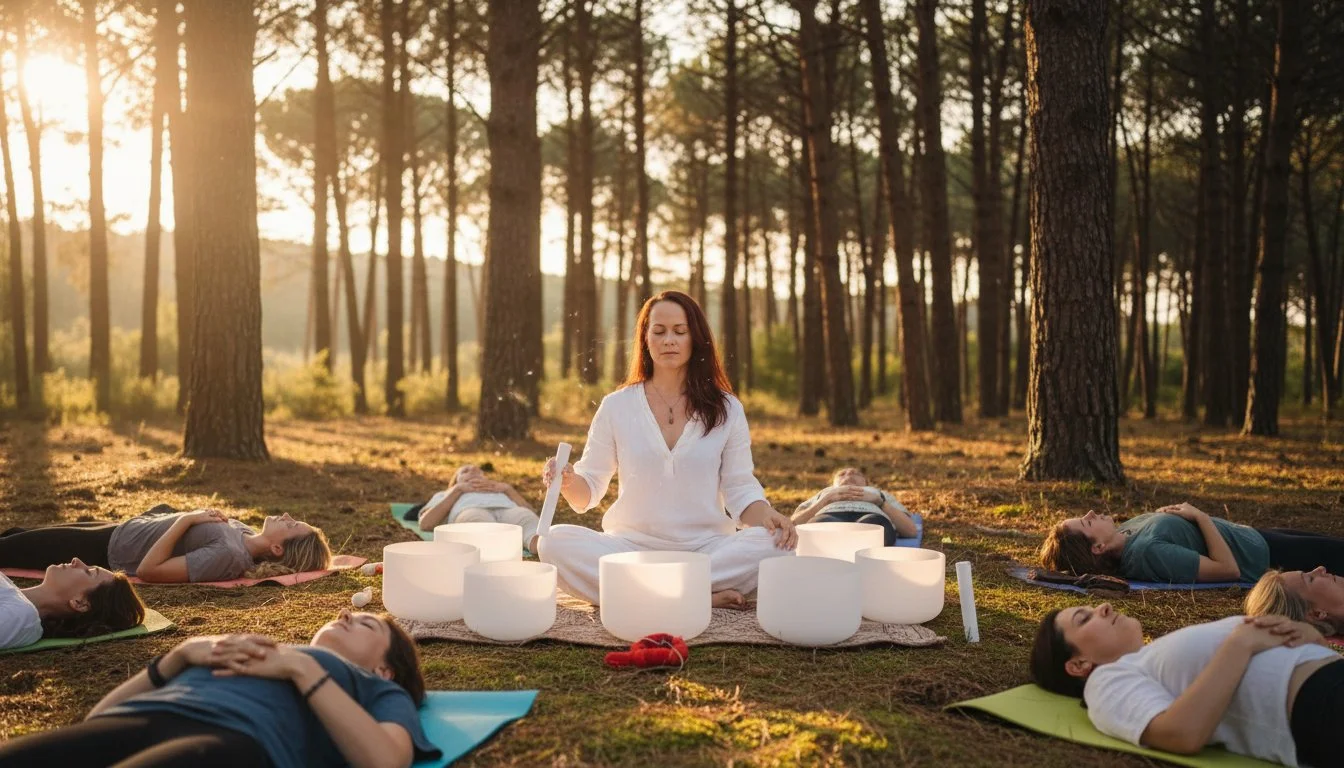
If your work asks you to hold space for other people, there's something your professional training may have barely addressed: what happens in your own nervous system while you're doing it.
You were taught frameworks. Techniques. How to listen, guide, attune, stay present.
But very few helping professions teach us to think of our own nervous system as part of what we're bringing into the room.
And I don't mean that in the usual protect yourself from burnout, don't give too much, remember to rest sense. All of that matters. But there's something more immediate underneath it.
Your nervous system is in the room too.
Not as a liability to manage. Not as something separate from the work that you have to take care of on the side.
It's part of how you meet the person in front of you.
What I mean by "in the room"
When you sit across from a client, a student, someone you're guiding through something difficult — you are not simply delivering information or technique. Whatever you know, however skilled you are, all of it arrives through you. Through your actual nervous system, your actual presence, your actual state in that exact hour.
This is easy to overlook because so much of professional training focuses entirely on what you know and what you do. Frameworks, techniques, the right words at the right moment. All genuinely valuable.
But underneath every technique is a simpler, less discussed fact: the person receiving it is also receiving you.
We pick up on one another constantly, often outside conscious awareness — a subtly held breath, a barely perceptible tension, a quality of attention that's either genuinely present or somewhere else entirely. A client or student may not consciously think, something is different today. But that doesn't mean our state has no bearing on the quality of the interaction.
I think this reframes the whole question of self-care for helpers. It isn't really about self-care in the sense of treating yourself kindly, though that matters too. It's about understanding that your own regulated presence is a working part of your professional instrument — arguably the part no technique can substitute for.
How I learned this, slowly and somewhat reluctantly
I didn't arrive at this understanding through a tidy insight. I arrived at it by guiding other people through yoga, breathwork, and sound — practices meant to help them regulate — while my own system was, at various points, genuinely struggling.
There's a particular kind of dissonance in guiding someone through a grounding practice while your own chest is tight, your own breath shallow, your own mind somewhere else entirely — usually on the next session, or the one before, or something entirely unrelated that had simply followed you into the room.
For a long time, I assumed this was just part of the job. You push through. You show up regardless. The client's needs come first, always, and figuring out your own state is something you deal with later, privately, on your own time.
What I eventually noticed, though, was subtler and more uncomfortable than simple exhaustion.
I noticed that the quality of what I was offering shifted depending on my own regulation, even when my technique stayed identical.
The same words. The same guided practice. The same careful attention to what the person in front of me needed.
And yet something was different on the days I arrived dysregulated versus the days I arrived settled. I couldn't always name what was different. But I could feel it, and I suspect the people I was working with could too, even if neither of us said so out loud.
That was the moment this stopped being an abstract idea and became something I had to actually deal with.
Why this isn't the same conversation as burnout prevention
This is where I think the usual conversation about practitioner wellbeing stops too soon.
Burnout prevention treats your own regulation as a defensive measure — something you do to avoid a bad outcome down the line.
Rest so you don't collapse. Set boundaries so you don't resent your clients. Practice self-care so you don't quit the profession entirely in five years.
All reasonable, all somewhat true, and all fundamentally about avoiding a negative future.
What I'm describing is a different frame.
Your regulation isn't primarily about avoiding your own collapse. It's about the actual quality of what becomes possible in the room, right now, in this session, for this person in front of you.
The same practitioner, using the same skills, may offer a very different quality of presence depending on the state they're bringing into the room.
Think about co-regulation, a concept many helping professionals already understand — the way the presence of another person can influence our own sense of safety, activation, or settling.
If we're willing to acknowledge that our presence can help someone settle, it follows that our own state deserves attention too.
This means your own regulation isn't separate from your professional competence. It's part of it.
Arguably the part that can't be taught through technique alone, because it isn't a technique.
It's a state.
The particular shame in not having this figured out
I think there's something worth naming honestly here, because I suspect many people reading this feel it and rarely say it aloud: a specific kind of shame that comes with being the person who's supposed to have this handled.
You're the one others come to for regulation, for calm, for a steadying presence.
There's an unspoken expectation — sometimes external, often self-imposed — that you should therefore have your own nervous system somehow sorted, permanently, as a professional prerequisite.
When you don't — when you're lying awake at night, short-tempered with your own family, or running on empty without quite admitting it — it can feel like a private failure.
But being skilled at helping someone else regulate doesn't make you exempt from having a nervous system of your own.
And knowing regulation intellectually isn't the same as having practices that reliably support you when you're the one who needs them.
I don't think this shame serves anyone. It just adds another layer of depletion on top of the original one, and it keeps people from admitting, even to themselves, that they need something too.
What this actually asks of you

I don't think the answer here is dramatic.
It isn't quitting your profession, or restructuring your entire practice, or adding another hour of self-care to an already overfull day.
I think it starts much smaller: recognizing, honestly, that your own state before and during a session isn't incidental.
Building in a few minutes, even just a few, to actually check in with your own body before you begin — not to fix anything urgently, just to notice what you're bringing into the room.
And afterward, finding some way of helping your own system transition out of the session before moving immediately into the next demand.
This is, in its simplest form, holding space for yourself before you hold it for anyone else.
Not as an indulgence squeezed in around the real work.
As part of the real work.
An invitation, if this is landing
If this is landing, you don't need another piece of information about why regulation matters.
You need somewhere to experience being on the receiving end of it.
The Unspiral is a place to begin.
It's twenty minutes in which you're not the practitioner, teacher, guide, or person holding everything together. There's nobody on the other side of it who needs anything from you.
Just my voice, live flute, and an invitation to let yourself be the one being held for a while.
You can find it at soulbreathyoga.com/feltsense.
And this is also exactly why I'm creating The Regulation Ritual.
It's for the person who doesn't only want somewhere to land once they're depleted, but wants regulation to become something they return to regularly — grounding, breath, sound and deep rest woven into an ongoing practice of supporting their own nervous system.
You can join the waitlist at soulbreathyoga.com/regulation-ritual.
Your nervous system is in the room too. It always has been. And when the room is finally empty, it deserves the same care and attention you've spent the day offering everyone else.