
The sound underneath the words matters too
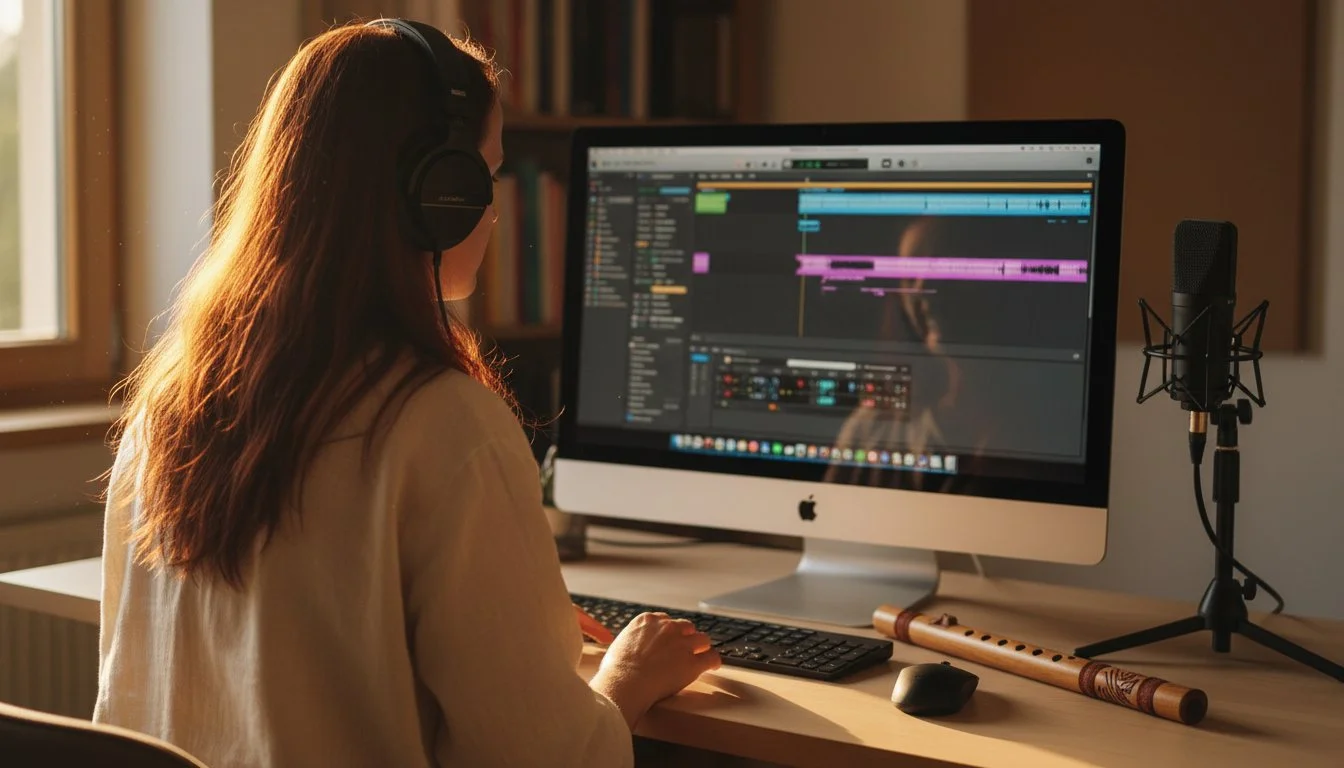
I've been spending a surprising amount of time thinking about the sound underneath my voice.
I'm building the audio for the Regulation Ritual at the moment, and initially I thought this part would be fairly simple. Find beautiful meditation music. Put it underneath the words. Done.
Except I kept listening to tracks that were perfectly lovely — and not quite right.
A piece of music could be calming on its own and still feel wrong underneath a particular practice. Something that worked beautifully for grounding didn't necessarily belong in a moment of coming back into energy. Sometimes the music was doing too much. Sometimes it filled a space I actually wanted to leave empty.
And slowly I realised I was asking the wrong question.
Not simply:
Does this sound beautiful?
But:
What is this sound doing here?
That question has changed quite a lot about the way I'm creating the Regulation Ritual.
When beautiful isn't enough
There is an extraordinary amount of meditation music available now.
I can open a music library and find hundreds of tracks described as peaceful, relaxing, healing, meditative, atmospheric or calming. Many of them are genuinely beautiful.
And for plenty of things, that's enough.
But as I started building the individual practices inside the Regulation Ritual, I realised I needed to listen differently.
I wasn't choosing music for someone to have playing pleasantly in the background while they cooked dinner or read a book. I was putting sound underneath words that were asking someone to pay attention to something specific.
Perhaps I'm asking you to notice the weight of your body.
Perhaps I'm asking you to feel your breath.
Perhaps we're moving into stillness.
Perhaps we're coming out of deep rest and I want to bring a little more aliveness back without suddenly jolting you out of the experience.
Those moments don't necessarily need the same sound.
And sometimes they don't need much sound at all.
That was probably the first real shift for me.
I stopped looking for meditation music as though it were one category of sound that could simply sit underneath everything, and started listening to what each particular moment needed.
Sometimes I would find a track I loved and desperately want it to work.
Then I'd put my voice over it.
And it didn't.
The music might be beautiful, but suddenly my words had to compete with it. Or there was a rhythm underneath a moment where I wanted someone to slow down. Or the sound was moving somewhere emotionally while the practice itself was asking the listener to stay exactly where they were.
There wasn't necessarily anything wrong with the music.
It just didn't belong there.
And I've become increasingly interested in that word: belong.
Does this sound belong with these words?
Does it belong with this pace?
Does it belong in this particular moment of the practice?
Does it leave enough space?
Once I started listening that way, I couldn't really go back to simply choosing something because it sounded calming.
Sound isn't just something underneath the practice
I've become much more aware of how sound changes the way a practice feels in the body, whether we're consciously paying attention to it or not.
You already know this from ordinary life.
A song can change the atmosphere in a room almost immediately. A sudden loud noise can make you tense before you've even worked out what it was. Someone speaking very quickly can leave you feeling rushed even when the words themselves aren't urgent.
And the opposite is true too. A familiar voice can be reassuring. A particular piece of music can bring back a memory before you've consciously remembered where you first heard it.
Sound is part of the experience.
My voice is part of it too.
The speed at which I speak matters. The spaces I leave between instructions matter. Whether I fill every silence because I'm uncomfortable with it, or allow you enough time to actually experience what I've just asked you to notice, matters.
So once I became that particular about the words and the voice, it started to feel strange to treat the sound underneath them as an afterthought.
That's really how I ended up here.
Not because I decided I needed to become a music producer.
I simply started caring more about whether all the different pieces of the practice belonged together.
Why my flute started becoming part of it
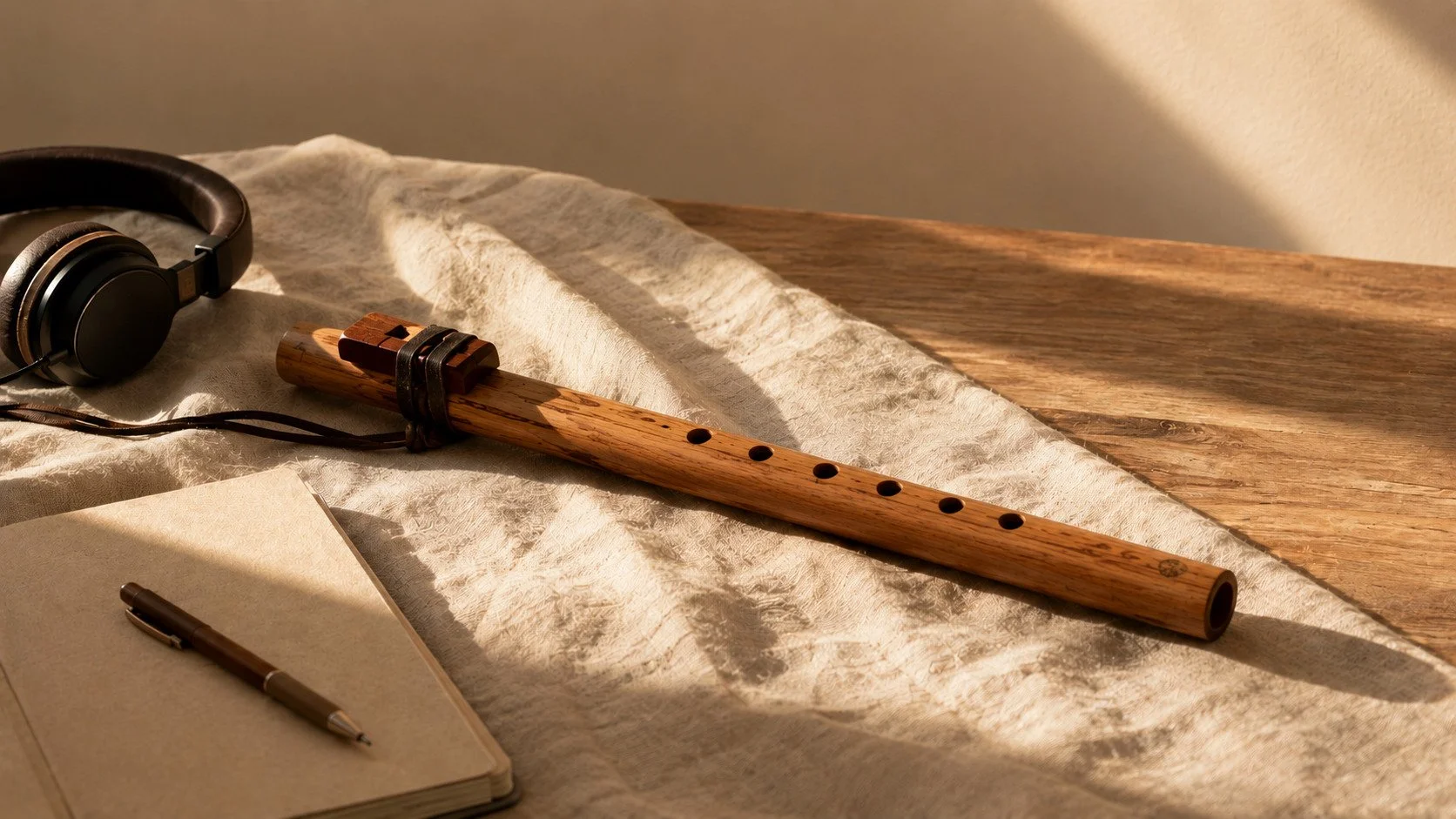
I've been learning and playing the flute, and increasingly I've wanted some of that sound inside the Regulation Ritual.
There is something very direct about recording an instrument that is played with your own breath.
I can hear when I'm relaxed.
I can also hear when I'm trying too hard.
Sometimes I record something and, while I'm playing it, I think it sounds lovely. Then I listen back later and hear tension in my breath that I hadn't noticed at the time.
Once I hear it, I don't want it underneath a practice that's asking someone else to soften.
So I record it again.
Sometimes the second recording is better.
Sometimes it isn't.
Sometimes I put the flute underneath my voice and realise that the thing I was so pleased with on its own doesn't actually work there at all.
So it comes out.
I'm learning as I go.
And strangely, I don't find that embarrassing. I find it quite interesting.
Because the point isn't to prove that I can produce an impressive piece of music. That's not what I'm making.
I'm creating a practice.
The sound has to serve the practice.
That gives me a very different measure of whether something is successful.
It doesn't have to make me think, What a beautiful piece of music.
I'd much rather it allows you to stay with yourself.
I'm learning to leave things out
This may be one of the biggest lessons in the whole process.
I've found myself choosing simplicity again and again.
There are so many things I could add.
Another instrument.
Another layer.
A little more atmosphere.
Something underneath the silence.
Something to make the transition feel fuller.
And sometimes adding something really does improve it.
But sometimes I listen back and realise I've made the practice busier simply because I had the ability to do so.
Then I start taking things away.
If I'm asking you to notice your body, follow my voice, feel your breath or soften into rest, I don't want the sound competing for your attention.
Sometimes one flute is enough.
Sometimes a bowl is enough.
Sometimes my voice is enough.
And sometimes what the practice needs is space.
That last one has probably been the hardest for me to learn.
Silence can feel unfinished when you're the person creating the audio.
You hear the empty space and immediately think: Should something go there?
I'm beginning to realise that this isn't always an empty space that needs filling.
Sometimes the silence is part of the practice.
It gives the previous words somewhere to land.
It gives you time to notice what is actually happening instead of immediately following me into the next instruction.
It lets your attention stay with your own experience for a moment.
I'm learning that creating the sound is as much about what I leave out as what I put in.
There is a difference between simple and careless
I also want to make this distinction because “keeping it simple” can sound as though I'm saying it doesn't matter very much.
For me, it's almost the opposite.
The simpler something becomes, the more noticeable each choice is.
If there are ten layers of sound, one small element can disappear inside everything else.
If there is my voice, one flute and a lot of space, suddenly every entrance matters.
When does the flute begin?
How long does it stay?
Does it continue underneath the words?
Would this sentence feel better without anything beneath it?
Does the sound need to fade here, or am I fading it simply because that's what audio tracks usually do?
I'm asking myself these kinds of questions constantly at the moment.
I don't always know the answer immediately.
Often I have to listen.
Then listen again.
Walk away from it.
Come back the next day.
Hear something I didn't hear the first time.
Change it.
This part of building the Regulation Ritual is taking longer than I expected.
But I don't particularly want to rush it.
I'm still using sounds I didn't make
One thing I want to be clear about is that making some of my own sound doesn't mean I've decided everything inside the Regulation Ritual has to be recorded by me.
I still use sounds from libraries when they're right.
There are textures I can't create myself, and there is no reason I should.
The shift has been in how I choose them.
Nothing goes in by default anymore.
Whether it's my flute, a bowl, a sound I've recorded myself or something from a library, I keep coming back to the same question:
Does this actually belong here?
That's more important to me than being able to say I made every sound myself.
In fact, making everything myself just for the sake of being able to say that would be another kind of ego getting in the way of the practice.
The person listening doesn't need to know where every layer came from.
They need the experience to work as a whole.
That's what I'm interested in.
The sound has to work with the words
This is probably where my work with sound connects most clearly with everything else I've been building.
I spend a lot of time choosing words.
Anyone who writes or teaches knows how much difference one word can make.
“Relax” can feel very different from “notice.”
“Let go” can feel very different from “you don't need to hold this right now.”
“Take a deep breath” can create an entirely different response from “let the breath arrive quietly.”
The language matters because the body on the receiving end isn't an abstract idea.
There's an actual person listening.
And sound deserves the same attention.
If my words are saying, there's nothing you need to do right now, while the music underneath them is busy, building, rhythmic or emotionally demanding, those two things don't quite belong together.
I want the sound to support what I'm saying without simply illustrating every word.
I don't need a musical cue every time something changes.
I don't want the practice to become a soundtrack telling you what you're supposed to feel.
There needs to be room for your own experience.
That is becoming increasingly important to me.
I'm not trying to manufacture a particular emotional response.
I'm trying to create conditions in which you have enough space to notice your own.
My own state becomes part of the recording too
This has been another interesting discovery.
I can't completely separate myself from what I'm recording.
Especially with the flute.
There are days when I can sit down and play and everything feels spacious.
And there are days when I try to record because I've decided that today is a recording day — and my body clearly has other ideas.
My breathing feels tight.
I'm impatient.
I'm trying to get the take right.
I can hear myself trying.
And that usually isn't the recording I keep.
I've started paying more attention to my own state before I press record.
Sometimes that means I need a few minutes first.
Sometimes it means I record another day.
This has made the whole process slower, but it has also made it more honest.
I can't ask someone listening to stop forcing something while I'm forcing the sound underneath them.
There is something quite beautiful about that accountability.
The practice I'm making for someone else keeps asking me to practise too.
What I'm actually building
I talk about the Regulation Ritual as grounding, breath, sound and deep rest.
Those are the practices.
But underneath them, I'm beginning to see another thread that connects the whole thing:
intentionality.
I don't want anything there simply because that's what a meditation is supposed to contain.
I don't want breathwork because breathwork is popular.
I don't want music because guided practices are expected to have music underneath them.
I don't want silence because silence sounds spiritual.
Each element needs a reason to be there.
And I don't mean a complicated scientific reason that the person listening needs to understand.
Quite the opposite.
I want to do the thinking while I'm building it so that you don't have to do the thinking while you're inside it.
That may be the clearest way I can explain what I'm trying to create.
You shouldn't need to analyse the practice.
You shouldn't need to wonder whether you're doing it correctly every thirty seconds.
You shouldn't need to understand why the flute appeared or why it stopped.
My job is to make those choices before you arrive.
Your job is simply to experience what's there.
You may never notice any of this
The funny thing is, after spending all these hours thinking about sound, I don't actually want you thinking very much about it when you eventually listen.
In some ways, I hope you don't notice.
I don't want you lying there wondering why the flute entered at that particular moment.
I don't want you analysing why there is more silence here.
I don't want you thinking about whether the sound underneath my voice came from my own instrument or from somewhere else.
I want the whole thing to feel as though it belongs together.
The words.
My voice.
The breath.
The sound.
The spaces in between.
And perhaps that's the simplest way I can explain what I'm building with the Regulation Ritual:
Nothing is there by accident.
Some of it will be imperfect.
Some of it I'm still learning how to make.
Some things will probably change as I keep listening and refining.
I'm completely comfortable with that.
Intentional doesn't have to mean flawless.
It means I've paid attention.
It means I've asked why something is there.
It means I've listened again when something didn't feel right.
And it means I'm willing to take something beautiful out when it doesn't belong.
That's the part of this process I hadn't expected to care about quite so much.
But now that I do, I can't imagine building the Regulation Ritual any other way.
If you'd like to be there when it's ready, the waitlist is open:
Join the Regulation Ritual waitlist:soulbreathyoga.com/regulation-ritual
Something in you already knows the way home.