
Some days I don't want another instruction
There are days when another explanation, another technique, another invitation to breathe a certain way is simply more input.
More to process. More to remember. More to get right.
I notice this in myself sometimes, even doing the work I do.
Someone offers me a helpful suggestion or a useful reframe, and something in me quietly resists before I've even registered why.
It isn't necessarily that the suggestion is wrong.
Sometimes I just already have enough to hold.
I don't have room left for one more thing that requires something from me.
And I suspect many of us know that feeling.
When even a gentle practice feels like another task
There's a difference between being supported by a practice and feeling as though you have to perform it correctly.
Sometimes guidance can feel like relief. Someone else holds the structure for a while. You don't have to plan what comes next.
But even a gentle practice can start to feel like another task when you're already depleted.
Breathe this way.
Notice this.
Count to four.
Follow this sequence.
None of those instructions are inherently a problem. There are times when structure is exactly what I want.
But there are other days when I notice myself thinking:
Please don't give me one more thing to do well.
On those days, I don't necessarily want the absence of guidance.
I want guidance that asks very little of me.
Something that helps me notice what's already happening rather than immediately asking me to change it.
And sound has become one of my favourite ways into that.
What sound asks of you
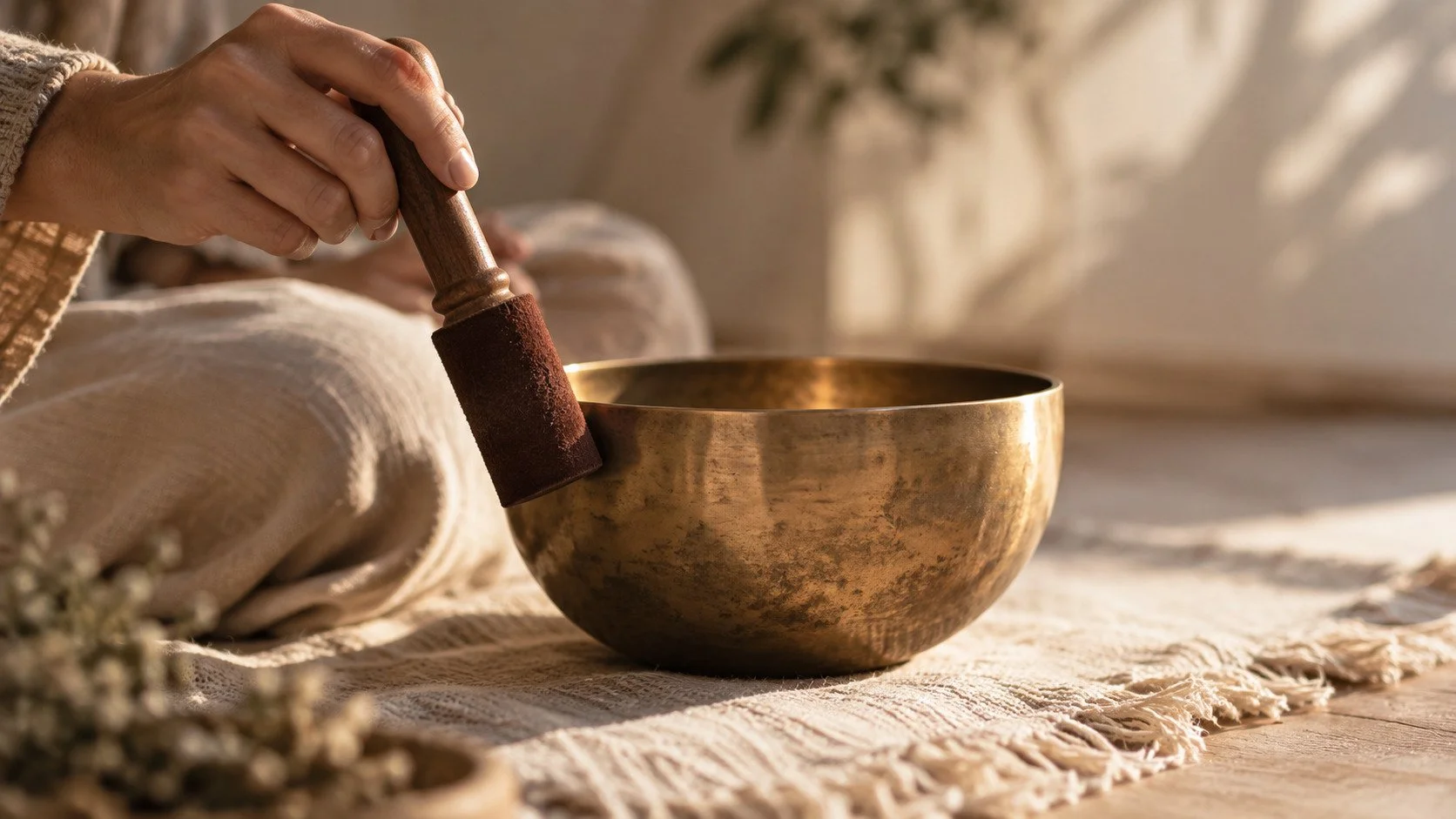
When a bowl is struck, you don't have to breathe correctly to hear it.
You don't have to sit in a particular way.
You don't have to decide what the sound means.
It arrives.
It moves through the room.
And you can simply notice what happens as you listen.
Maybe you feel the vibration somewhere in your body. Maybe you don't.
Maybe you notice it strongly in your chest or hands. Maybe what catches your attention is simply the sound itself.
There's no particular sensation you're supposed to find.
That's important to me.
Because the invitation isn't:
Can you do this correctly?
It's:
What do you notice?
Those are very different questions.
I can guide your attention. I can invite you to become curious about sensation. But I don't need you to produce a particular experience for the practice to have been worthwhile.
You aren't trying to perform presence.
You're simply noticing what's here.
I don't need to tell you that a bowl is healing something
There's something else I want to be clear about when I talk about sound.
I'm not going to tell you that a crystal bowl at a particular frequency heals a particular part of your nervous system. And I'm not interested in attaching a Hertz number to an experience as though the number itself proves what is happening in someone's body.
I don't need those claims to explain why sound has a place in my work.
What I can speak about is what I've observed through years of sitting with people while sound moves through a room.
I've seen shoulders soften.
I've watched expressions change.
I've noticed breathing shift without me giving an instruction to change it.
Not for everyone. Not every time. And not because I'm claiming the bowl has produced a particular physiological effect.
What interests me is the experience of being given something to notice without immediately being given something to do.
Listen to a sound disappear

Think about the moment just after a bowl is struck.
At first, the sound is full and unmistakable.
And then it begins to change.
It thins.
Softens.
Fades.
Until at some point you're no longer listening to the bowl.
You're listening to the space where the bowl was.
I've watched attention follow that fading sound with remarkably little instruction.
You don't have to concentrate fiercely on a sound disappearing.
There is simply something there to follow.
And then comes the silence.
I've come to value that silence as much as the tone itself.
Not empty space that needs to be filled.
Not a pause before I hurry in with the next instruction.
Just room.
Room for whatever you noticed to be there for another moment.
This is why sound runs through the Regulation Ritual
Sound isn't a separate practice inside the Regulation Ritual.
It's woven through it.
Through the grounding.
Through the breath.
Through the deep rest of Yoga Nidra.
Through the return.
My voice is part of that soundscape. So is my flute. And so are the other sounds I choose to bring in — or deliberately leave out.
I've been thinking carefully about this as I build each recording.
Not simply:
Does this sound beautiful?
But:
What is this sound doing here?
Does it support the moment?
Does it give attention somewhere to rest?
Does it need to be here at all?
Or would silence do the job better?
Because I don't want sound to become another layer of stimulation simply because I can add it.
Sometimes the most supportive thing I can do is play something.
Sometimes it's to stop.
A small experiment with receiving
If you have a singing bowl or a bell nearby, you can try this.
And if you don't, a glass you can gently tap is enough.
Let it sound once.
Don't deliberately change your breathing.
Don't try to relax.
Don't decide beforehand what you're supposed to feel.
Just listen.
Notice whether you experience the sound only through your ears or whether you notice anything elsewhere in your body too.
And then follow the sound as it fades.
All the way.
Until you're not quite sure whether you're still hearing it or remembering it.
Then stay for another moment.
Don't rush to fill the silence.
Notice what's there.
That's all.
No particular result required.
For the days when you don't want another instruction
Some days I want a practice.
I want someone to tell me where to place my attention. I want structure. I want to be guided through something from beginning to end.
And some days even the gentlest technique feels like one more thing I'm being asked to do.
I've stopped believing those days require me to try harder.
Sometimes they simply require a different doorway.
Sound can be one of those doorways for me.
Not because I believe a bowl will do the work for you.
But because listening can give your attention somewhere to go without demanding that you immediately change what you find.
And that's one reason sound has such an intentional place inside the Regulation Ritual.
You're still being guided.
There's still a structure holding you.
But within that structure, there is room to notice.
Room to receive.
And room for silence too.
The Regulation Ritual is still taking shape, one recording at a time. If you'd like to be there when it opens, you can join the waitlist here:
soulbreathyoga.com/regulation-ritual
You don't have to do everything correctly today.
Sometimes it's enough to listen to what's already here.