
This is my own medicine — how the flute taught me what solar and lunar energy actually feel like
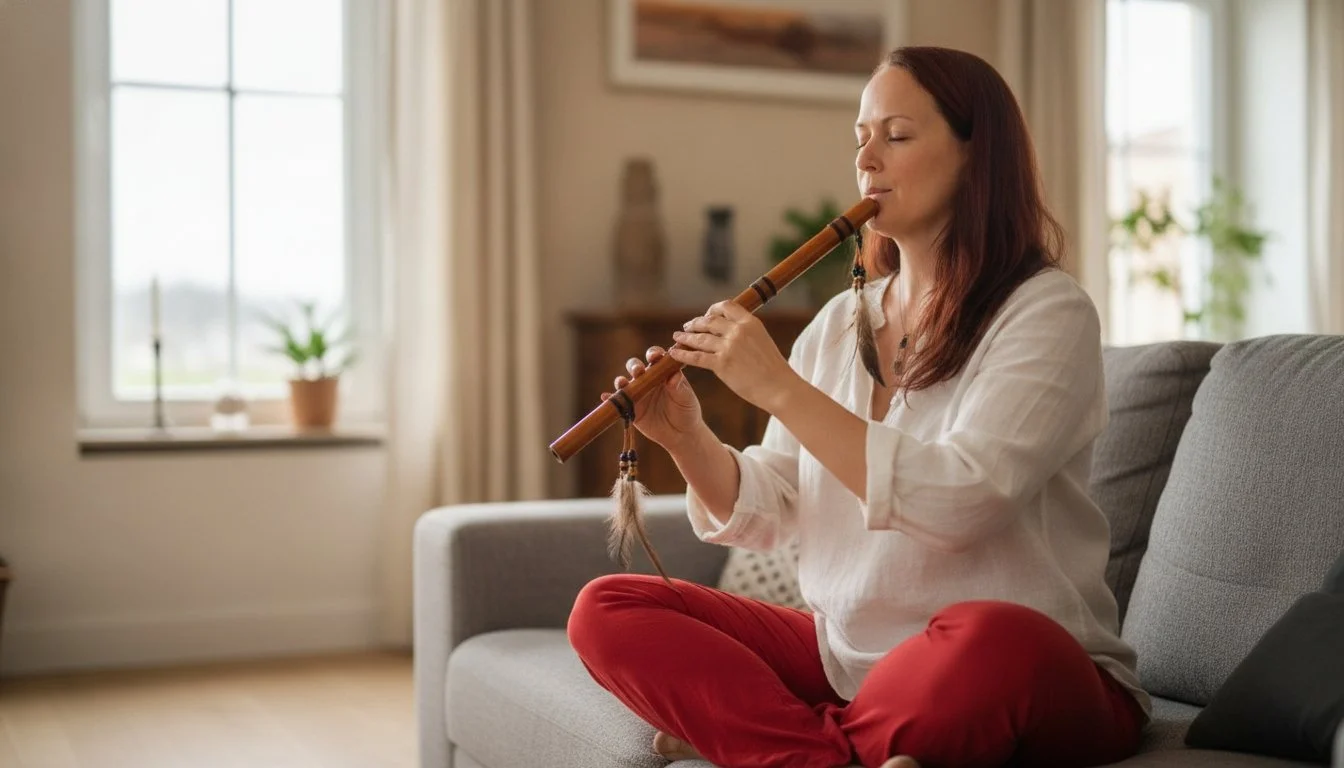
I have been feeling the pull toward the Native American flute my whole life. A few months ago I finally said yes. I did not expect it to teach me anything. I just wanted to play.
I bought the flute almost on impulse, the way you say yes to something you have been circling for years without admitting it. My first sounds out of it were rough. Breathy in the wrong places. Nothing like the recordings I had listened to for two decades.
The pull was there even as a child. I played a little at school, then stopped, the way life just moves on and other things take over. But the flute kept calling me back, year after year, until I finally found one: a Native American style flute, built on a pentatonic scale. The moment I started playing, something in me lit up. It goes straight to my heart. Straight to something in me that has nothing to do with words. I feel happy every single time I play it.
And I noticed something else: depending on how you play it, this instrument can be almost anything. Awakening or grounding. Bright or deep. Solar or lunar.
One evening, I felt the difference
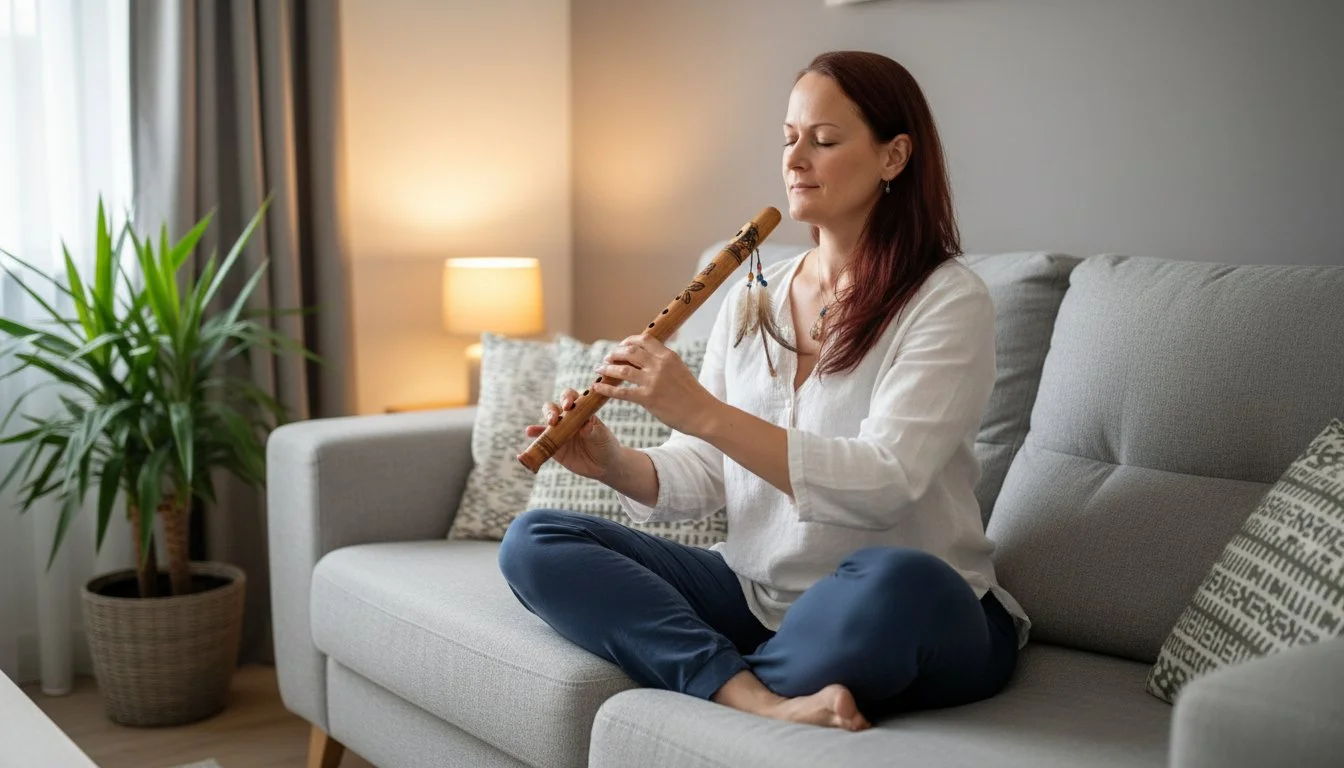
One evening I was playing without thinking about anything in particular, just following the breath, and the flute settled into something low and long. Almost a hum. Breathy, but not by accident anymore — just the sound finding its own shape. My shoulders dropped before I noticed they'd been up. My jaw let go. My breathing slowed down on its own, like something in me had been waiting for permission to stop holding its breath.
And then, almost without deciding to, I picked up the pace. Shorter breaths, brighter notes, a rhythm instead of a hum. And everything in me changed direction. My spine straightened. My face was smiling before I noticed that too. That same instrument, ten seconds later, was doing something completely different in my body — and I felt it, not as a concept I could explain to someone else, but as something happening in me, right there in my own hands.
That's the moment I understood it: the flute itself has two notes like this in it, a low grounding one and a bright awakening one. And my own nervous system works exactly the same way. A nervous system that can only ever go quiet, that can only ever cool down, is only using half the range it actually has.
There's a difference between understanding something as a theory you teach and actually feeling it move through your body. That evening, energy I had already understood in my mind became something I felt directly — solar and lunar not as concepts, but as real sensations in my own chest.
Every sound healing instrument has this range in it
Since then, I've started bringing the flute into the sound healing journeys I guide — alongside the crystal singing bowls, the shamanic drum, the rain stick, the seed shaker, my own voice. And I've started noticing this same range in every single one of them.
The crystal bowls can hold a room in deep stillness, or, played faster and higher, they can lift a room's energy until people are almost buzzing. The shamanic drum can ground a whole group into their bodies with one steady heartbeat rhythm, or it can build and quicken until something in the room wants to move. None of these instruments are only calming, and none of them are only activating. They are all capable of both — solar and lunar, depending on how and where I play them, and depending on what the people in front of me actually need that day.
This is what makes sound work so powerful to me. It isn't decoration underneath a meditation. It's a language of its own, one that can meet a nervous system exactly where it is and gently move it somewhere new.
What the sound is actually doing underneath a meditation
When someone listens to one of my guided meditations, the words are only part of what is happening to them. Underneath the voice, the sound is doing its own separate work — and it is not random.
A low, sustained tone — the flute held long, or a crystal bowl allowed to ring out fully — slows the pace of everything around it. Your own breath tends to follow it, almost against your will, stretching out to match. This is the sound working in a lunar direction: inviting the body toward rest, toward digestion, toward the kind of stillness where something can finally be released rather than managed.
A quicker, rhythmic pulse does something completely different. A drum played in a steady, driving rhythm — or the flute moving in short, bright phrases — tends to sharpen attention rather than soften it. It can pull a wandering mind back into the room. It can be used to build focus, to gather scattered energy into one place, to give a person something to follow when their thoughts are moving faster than they can manage on their own. This is the sound working in a solar direction — not agitating, but energising. Calling the body's attention rather than alarming it.
I choose deliberately between these before I ever open my mouth to guide a meditation. If a group walks in wired and scattered, I will sometimes start with rhythm — something to give their nervous system a container to organize around — before I ever ask them to slow down. If a group walks in flat and depleted, I might start there too, using rhythm to wake the room gently before inviting stillness. And when a room is ready to simply receive, I let the long tones do their work, unhurried, with nowhere else to be.
This is what I mean when I say the sound is never casual. Every meditation I create has a sound journey built underneath it, chosen note by note, instrument by instrument, with a very specific question in mind: what does this particular body, in this particular state, actually need right now? Sometimes the answer is stillness. Sometimes it is fire. Often, over the course of twenty minutes, it is both — moving a person from one state into the other, the way my own evening with the flute moved me.
I love this part of what I do more than I can easily explain. It's some of the most alive work I do in my whole practice. Nothing about the sound is casual. Every choice is intentional, built to bring a body from where it is into somewhere more spacious.
Bringing it into the room with others
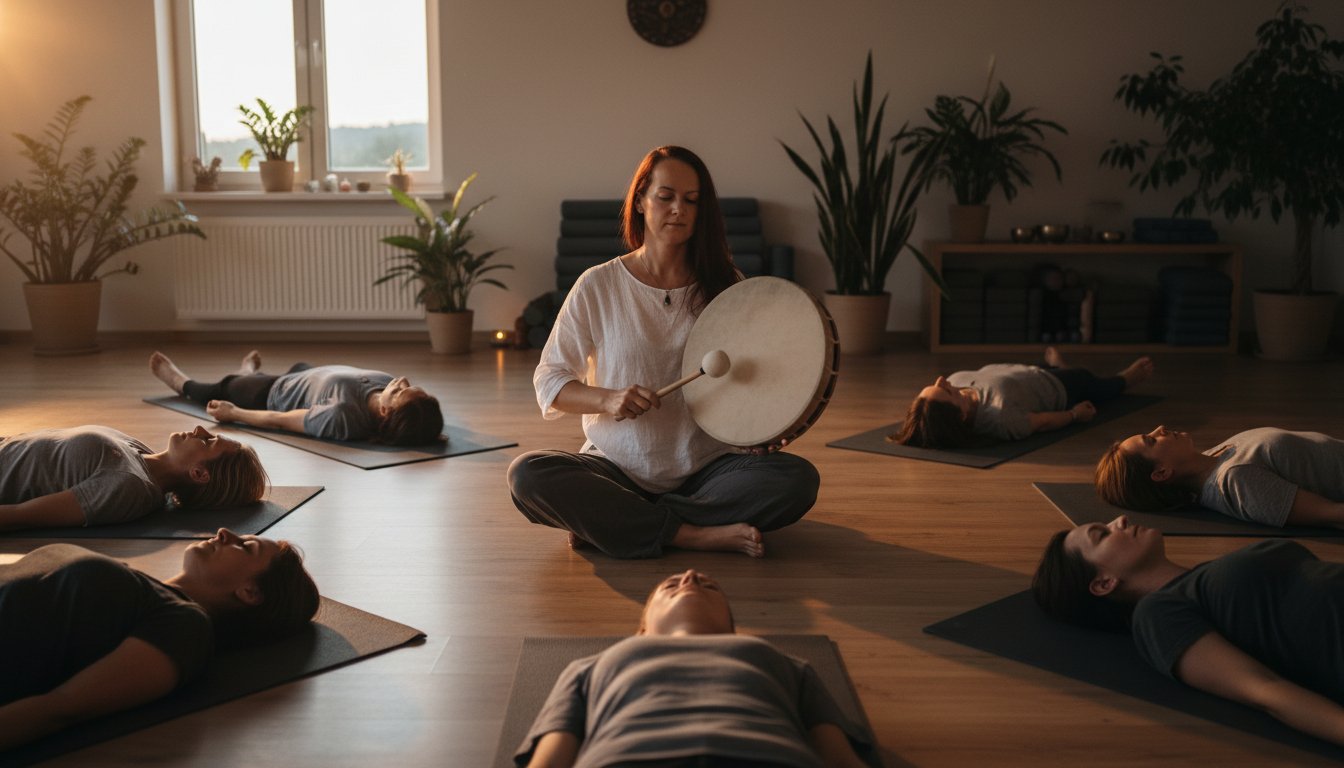
The flute does something special the moment it enters a room. People notice it immediately — a stillness settling in, or sometimes the opposite, a kind of quickening, depending on where the group needs to go that day.
I didn't expect that. I thought the flute was mine, private, something I'd found late and was still learning. But the thing that moved me that evening moves other people too. That's often how it goes with the practices I end up sharing — they start as something just for me, and only later do I realize they belong to more than just me.
What this actually means for regulation
Most conversations about nervous system regulation stop at "find your calm." And calm matters — it's real, it's necessary, it's often the very first thing a wired-but-tired body needs. But an instrument that could only ever soothe you would eventually get boring. What makes the flute alive in my hands isn't just that it can settle me. It's that it can also wake something up in me — brighten me, quicken my breath, put a smile on my face before I've consciously decided to smile.
That's what a regulated nervous system actually looks like, underneath all the language we use to describe it. Not a system stuck in one gear. A system that can move — into rest when rest is needed, into brightness when brightness is needed — and come back to itself either way. Fire and stillness, not one instead of the other.
This is the same understanding I wrote about last week, when I talked about why yoga has always known that regulation needs both solar and lunar energy — activation and rest, expansion and cooling. The flute didn't teach me anything new, exactly. It gave me a way to feel these energies even more strongly in my own body, not just understand them in my mind.
Where to start, if any of this speaks to you
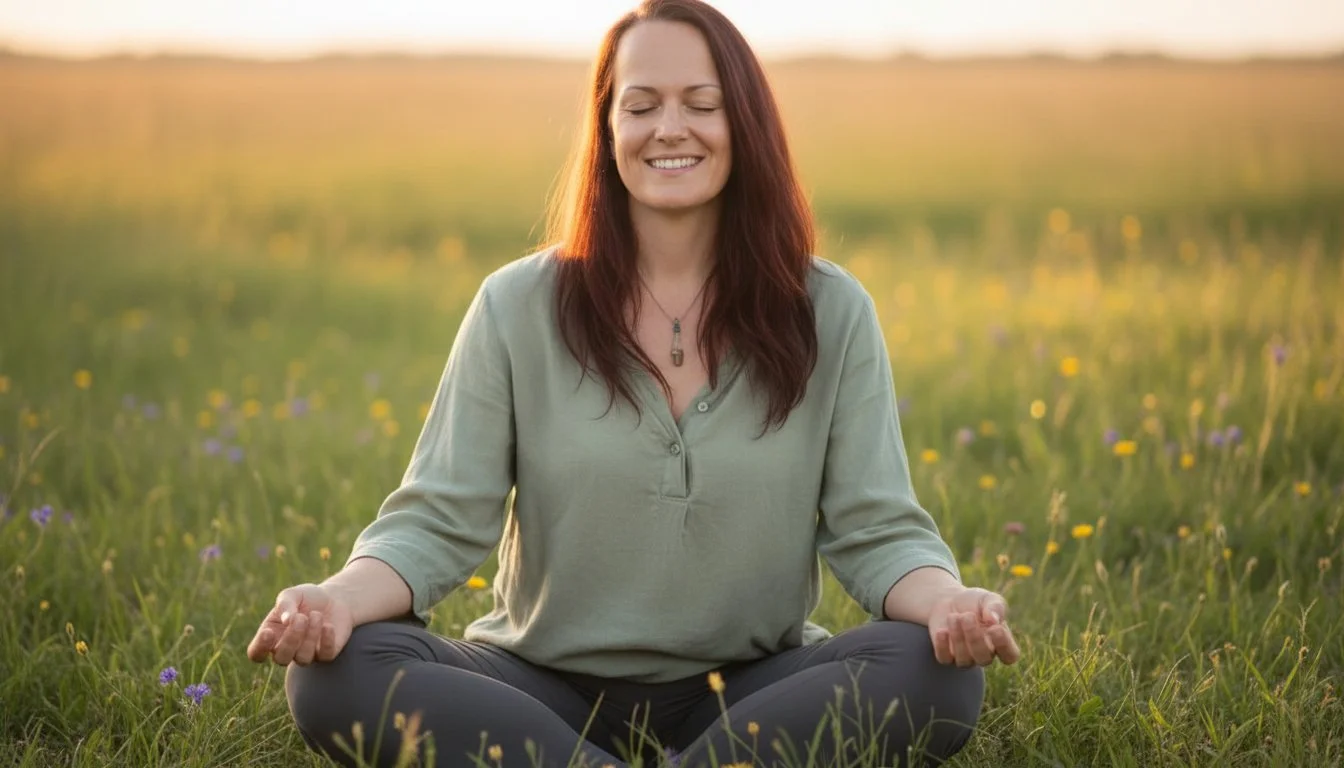
If you've read this far and felt something — a little envy, maybe, for a body that gets to feel that kind of range, or a quiet wish that you could find your own version of that shift — I want to tell you two things.
The first is that you don't need an instrument, or years of practice, or anything you don't already have. You just need somewhere to start.
The Unspiral meditation is that starting point. It's a twenty-minute felt sense meditation I created using nothing but my voice and this same flute — no music production, no layers, just the two things that moved me that evening. It's free, and it's the gentlest possible way to feel, even briefly, what it's like when your body gets permission to settle. If you haven't tried it yet, this feels like the right moment. You can find it at soulbreathyoga.com/feltsense.
And if you're ready to go a little deeper — to build something more lasting than a single twenty-minute experience — that's where the Regulation Ritual comes in. It's the lunar foundation of everything I teach: grounding, breathwork, Yoga Nidra, and rest, built to be returned to again and again until your body starts to trust it. It's where I'd point you if you're looking for a genuine first step into this work, not the whole range yet, just the ground beneath it. You can join the waitlist at soulbreathyoga.com/regulation-ritual.
Solar can come later. Lunar is where we begin.