
You have tried to build a morning practice. Multiple times.
You set the alarm earlier. You laid out the yoga mat the night before. You downloaded the app, bought the journal, bookmarked the breathwork video. And for a while — sometimes a few days, sometimes a few weeks — it worked. You felt better. Clearer. More like yourself.
And then quietly, without drama, it stopped. A difficult week arrived. Or exhaustion. Or simply the accumulated weight of everything else. And the practice fell away, and you told yourself you would start again on Monday.
Monday came. And went.
If this is familiar, I want you to hear something clearly: this is not a discipline problem. It is not a willpower problem. It is not evidence that you are somehow less committed or less capable than the women who seem to maintain their practices effortlessly.
Routines collapse for a specific physiological reason. And until that reason is addressed, no amount of motivation, accountability, or perfectly designed morning routines will make them stick.
The real reason routines collapse
A dysregulated nervous system resists new patterns.
This is not a metaphor. It is how the nervous system actually functions. When the body has been in chronic stress — running on alert, holding too much, moving through life in a state of low-level bracing — it becomes deeply resistant to change. Not because you are lazy or unmotivated, but because the nervous system reads unfamiliar patterns as potential threat and pulls you back towards what it knows.
This is why the first few days of a new routine feel possible — novelty generates a small burst of energy and motivation. And why by day four or five, when the novelty has worn off and the nervous system has registered that this new pattern requires something different of it, the resistance quietly activates.
You don’t decide to stop. It just becomes harder and harder to begin. Until one morning you don’t, and the practice is over.
The missing piece in almost every habit-building conversation is regulation.
Before a new pattern can become sustainable, the nervous system needs to feel safe enough to hold it. Without that foundation, you are building on unstable ground — and the ground will shift.
What calm without vitality actually feels like
There is a particular state that many women describe when they have been working very hard on themselves for a long time. They have done the therapy, the meditation, the breathwork. They have learned to pause before reacting. They have reduced the obvious sources of stress in their lives.
They are calmer. But they do not feel alive.
There is a flatness to their days. A sense of going through the motions. They are no longer spinning in anxiety but they are not present either — not lit up, not engaged, not fully inhabiting their own lives. They describe it as feeling muted. Like the volume of everything has been turned down.
This is not what regulation is supposed to look like.
Calm without vitality is not the destination. It is a halfway point — better than chronic dysregulation, but not the full picture. A genuinely regulated nervous system is not flat or muted. It is present, responsive, and capable of feeling deeply. It can hold both stillness and aliveness at the same time. It can rest completely and engage fully. It is, in the truest sense, at home in the body.
What the land taught me
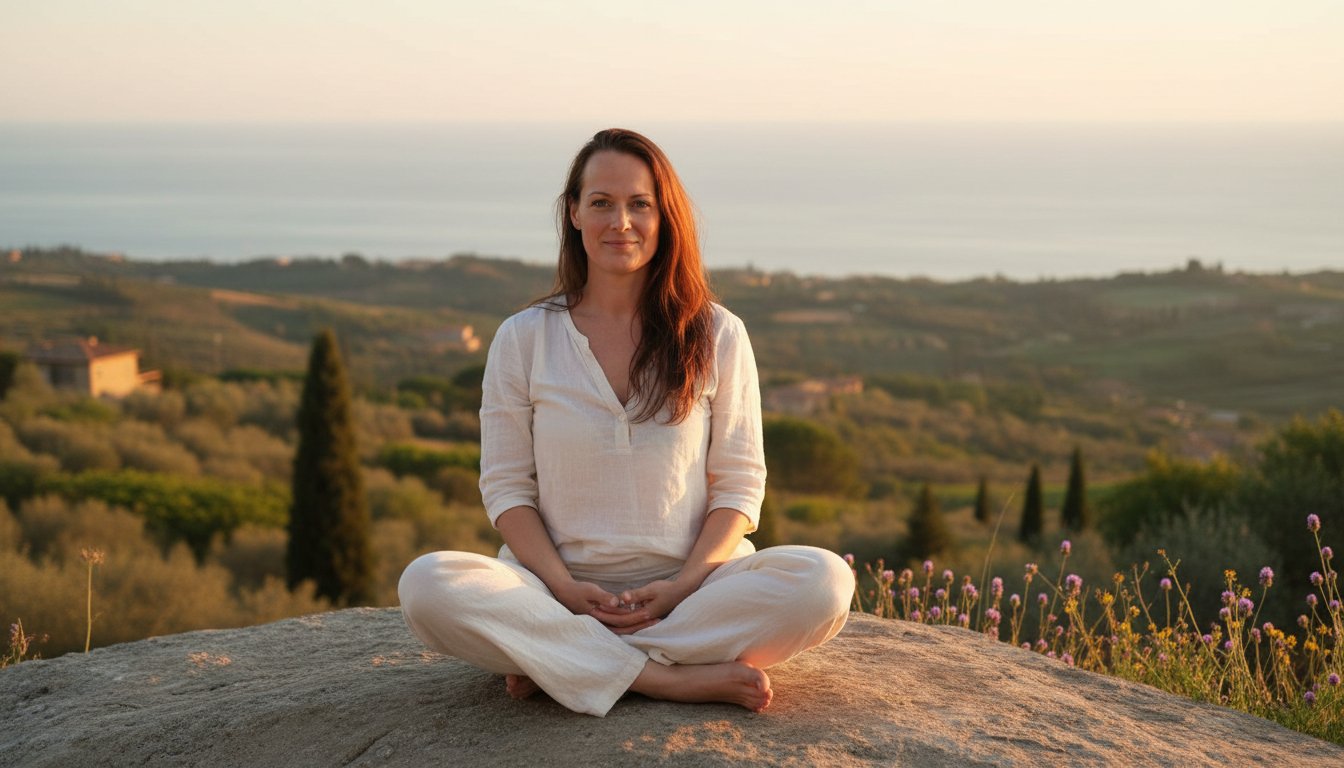
I live in Tuscany. In the hills above the sea, surrounded by olive trees and lavender and the particular quality of light that this part of the world holds in the late afternoon — golden, thick, almost tangible.
I did not always live here. I arrived after years of living differently — in cities, in movement, in the kind of busyness that feels productive right up until the moment the body refuses to continue. I came to Tuscany partly by choice and partly because something in me needed to stop — needed earth beneath my feet and the sound of the sea.
What I found, slowly and without drama, was that the land itself is regulating. Not in a mystical sense — in a physiological one. The quality of the air. The way the light changes through the day. The sound of wind in the olive trees. The feeling of sand between your toes at the end of the day.
These things speak directly to the nervous system in ways that no practice I had tried indoors could quite replicate. Not because nature is magic, but because the human nervous system evolved in nature. Stephen Porges, who developed Polyvagal Theory, described this through the concept of neuroception — the nervous system’s continuous, subconscious scanning of the environment for signals of safety or threat. Before you have consciously registered anything, your nervous system has already assessed the landscape around you. The sounds and rhythms and textures of the natural world carry specific signals that the nervous system has been reading for thousands of years. They speak a language the body already knows.
I started building my practices outdoors. Bare feet on the earth. Breathing with the rhythm of the wind. Movement that followed the quality of the morning rather than a preset sequence. And for the first time, my practices held. Not because I was more disciplined. Because the foundation had changed.
Grounding is not a metaphor — it is a nervous system intervention
The word grounding is used so frequently in wellness spaces that it has almost lost its meaning. It has become synonymous with ‘calming down’ or ‘centering yourself’ — vague, pleasant, slightly aspirational.
But physiological grounding — the actual contact of the body with the earth — is a specific and measurable intervention. Research into earthing or grounding has shown that direct skin contact with the earth’s surface allows a transfer of electrons that has measurable effects on inflammation, cortisol levels, and autonomic nervous system function. The body literally receives a signal from the earth.
Beyond the physiology, there is something simpler and perhaps more fundamental. When you stand barefoot on earth — when you feel the temperature, the texture, the slight give of soil or the solidity of stone — you receive sensory information that orients the nervous system in space. You know where you are. You know that you are held. The body, which has been bracing and holding and managing, registers something beneath it that will not move.
This is the foundation that routines need. Not motivation. Not discipline. Not the right system or the best app. A nervous system that has received enough signals of safety to begin, slowly, to trust that stillness is possible.
A practice for coming home to the body: feet on earth
This is the simplest practice I know. It asks almost nothing of you. And it works.
Find a patch of earth — grass, soil, stone, sand. Remove your shoes and socks. Step onto it.
Stand still for a moment. Feel the temperature of the ground beneath your feet. Feel where it is warm, where it is cool, where it is smooth, where it is uneven.
Let your weight drop down through your feet. Just let it happen.
Breathe. Notice what happens in your shoulders as you exhale.
Stay for two minutes. Or five. Or twenty. There is no minimum and no maximum. The practice is simply the noticing — the quality of the ground, the quality of the breath, the body settling.
You can do this before your morning practice, as the opening of it. You can do it at the end of a difficult day. You can do it when a routine has collapsed and you don’t know how to begin again. You don’t need to be in Tuscany.
You need only earth and bare feet and a willingness to feel.
Building from the ground up
When I work with women on building sustainable practices, we always start here. Not with the schedule or the sequence or the goals. With the nervous system. With regulation.
Because a practice that emerges from a regulated nervous system is completely different from a practice imposed on a dysregulated one. The first feels like coming home. The second feels like another item on the list of things you are failing to do.
The goal is not calm.
The goal is a body that is present, responsive, and genuinely at home in itself. A body that can rest deeply and feel fully and move through the world without perpetually bracing against it.
That is what regulation in service of vitality looks like. And it begins not with ambition, but with the ground beneath your feet.
Where to begin tonight
If you have never worked with your nervous system directly — if your practices have always lived in the mind rather than the body — the Unspiral meditation is a gentle and accessible place to start.
It is twenty minutes of guided felt sense awareness with my voice and live Native American flute. It asks nothing of you except to lie down and listen. And it begins the process of teaching the nervous system — slowly, gently, through direct bodily experience — that it is safe to soften.
It is free: soulbreathyoga.com/feltsense
And if you are ready to go deeper — to build a practice that lasts — I am building something specifically for that. The Regulation Ritual is a short audio-led course designed for the woman who is exhausted but cannot switch off. It is coming soon, and you can join the waitlist via the link on my bio page: soulbreathyoga.com/links
For now: go outside. Take your shoes off. Let the earth hold you for a few minutes.